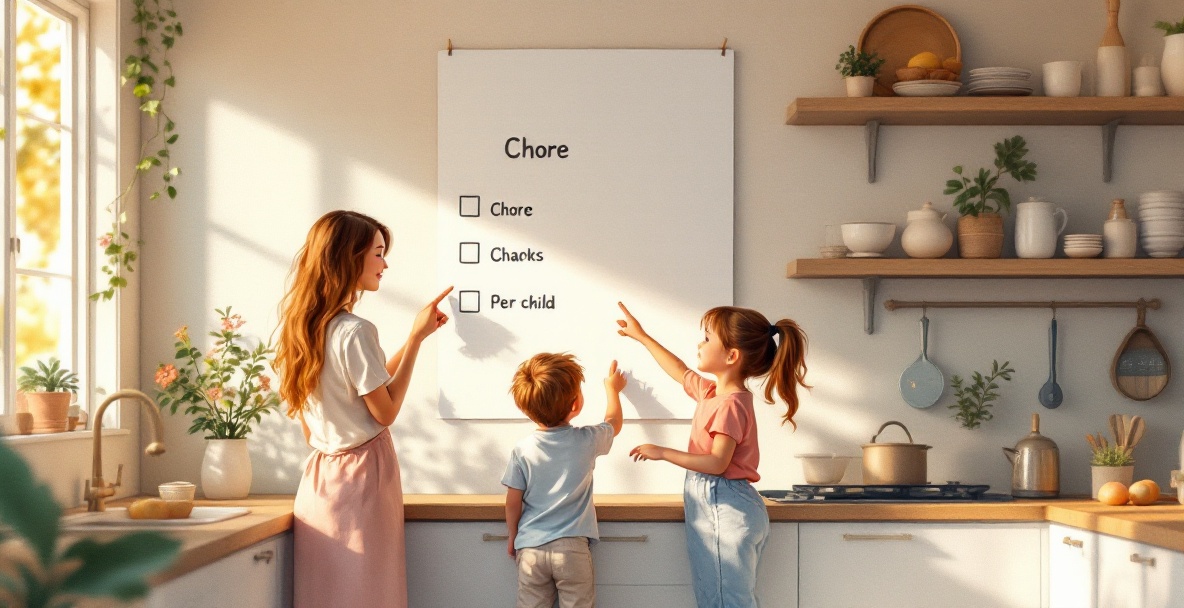
Quick Answer: A good behavior reward is a point, privilege, or small prize given after a child does something desired, like finishing a chore or sharing without being asked. It works through positive reinforcement, strengthening a behavior by pairing it with a pleasant outcome delivered close to the moment it happens.
By Maya Chen
Most parents try a reward chart at some point. The sticker goes up for a week or two, then someone forgets to log a day, and the whole thing fades. This article covers how a good behavior reward actually works, whether it's healthy to use one, and how to keep it running past week two, including when two households are involved.
What Is a Good Behavior Reward (And Why Parents Use Them)
A good behavior reward is a point, privilege, or small prize given to a child right after they do something desired, like putting shoes away or finishing homework without a reminder. The purpose is to make that action more likely to happen again, not to control the child in the moment.
This practice is commonly called "positive reinforcement," a term from behavioral psychology. It describes how adding a pleasant consequence after a behavior increases the chance that behavior repeats. Parents also use the plain phrase "rewarding good behavior" for the same idea in everyday life.
The two terms describe the same mechanism at different levels. Positive reinforcement is the broader psychological principle. Rewarding good behavior is the daily practice built on top of it, whether that's a sticker chart, a verbal compliment, or a point tracked in an app.
Is It Okay to Reward Kids for Good Behavior?
Yes, rewarding kids for good behavior is a widely accepted way to build habits when it's done consistently. Rewards are not bribery when they follow a behavior that already happened rather than being offered to stop a tantrum in progress.
The real challenge isn't whether to reward a child, it's keeping the system consistent. A chart that gets filled out Monday and Tuesday, then forgotten through the weekend, teaches a child the opposite lesson: that good behavior sometimes gets noticed and sometimes doesn't. Consistency across days and caregivers matters more than the size of any single reward.
Research Highlight: Research on rewards and penalties in children's social reasoning, published by the Living Lab research group, examines how kids interpret fairness in reward and penalty systems, a factor that shapes how seriously they take a reward chart over time.
A reward system that drops off after a busy week sends a confusing signal. Kids notice gaps faster than parents expect.
Positive Reward Ideas by Age
Positive reward ideas should match a child's developmental stage, since what motivates a toddler rarely works for a preteen.
- Ages 2-4: Verbal praise ("You put the blocks away, that was so helpful"), a sticker on a simple chart, a high-five, or a few extra minutes of a favorite activity.
- Ages 5-8: A point or token that counts toward a small prize, choosing the family dinner, or an extra bedtime story.
- Ages 9+: Privilege-based rewards like extra screen time, picking a weekend outing, or a small allowance bonus tied to a week of consistent tasks.
Social and verbal rewards cost nothing and work across almost every age group. Token and point systems tend to work best for kids who like seeing progress build visually. For a deeper breakdown of reinforcement techniques by age and situation, see this parent's guide to rewarding good behavior.
Reward Charts Vs. Digital Point Tracking
A paper reward chart and a digital point tracker both record the same basic unit, a mark for a completed behavior, but they handle consistency very differently. A paper chart depends entirely on whoever remembers to grab a marker that day. A digital system logs the action the moment a parent taps approve, so there's no gap between the behavior and the record of it.
Digital point tracking also makes task completion approval a visible step instead of a guess. A parent sees exactly what a child marked done, approves it, and the points land automatically. KidKarma's chore and reward app handles that loop: kids earn points for completing tasks, unlock rewards, and build positive habits while parents stay organized and connected.
| Feature | Paper Chart | Digital Point Tracking |
|---|---|---|
| Logging a completed task | Manual, easy to skip | Logged when approved in-app |
| Visibility for both parents | Requires physical access | Shared dashboard |
| Progress over time | Hard to review | Progress charts built in |
| Reward redemption | Informal, parent-tracked | Tracked in-app |
For a closer look at how KidKarma compares to another tracking approach, see this comparison of KidKarma and FamilyRewards. If you're weighing several app options at once, this roundup of chore and allowance apps compares six side by side.
Why Reward Systems Break Down (And How to Fix It)
Reward systems break down most often because of inconsistency, not because the reward itself stopped working. A parent gets busy, forgets to mark the chart for two days, and the child stops bothering to ask for credit.
Common failure points include:
- Forgetting to log a completed task on a busy day
- One parent carrying the entire tracking burden
- No clear record of what was already rewarded this week
Watch Out: A chart that lives on the refrigerator at one home is invisible at the other. Two-home families often end up with disputes over whether a chore was actually done, simply because nobody wrote it down in both places.
The fix isn't more willpower, it's a system that logs the action the moment it happens and makes that record visible to everyone involved, including a second household.
How to Run a Good Behavior Reward System With Two Co-Parents
Running a reward system across two homes works when both parents see the same list and the same history, not two separate charts that never line up. Without a shared record, a point earned at one house can get disputed or simply forgotten at the other.
KidKarma builds this in rather than treating it as an extra. Co-parents share one dashboard and both get approval notifications, included on every plan, Plus or Family, monthly or yearly. That means a chore approved at one home shows up instantly for the other parent, with no separate chart to compare at pickup.
Expert Commentary: KidKarma gives kids the list. You stop repeating yourself, and that applies the same way whether a child is at one home or splitting time between two.
This matters most for families managing custody schedules, where a reward earned on a Tuesday at one house needs to count the same way on Thursday at the other. One shared dashboard removes the guesswork.
Setting Up Your Own Good Behavior Reward System
Setting up a good behavior reward system takes a handful of steps, whether you're starting from scratch or replacing a paper chart that's stopped working.
- Create tasks. List two to four specific behaviors or chores you want to reinforce, sized to your child's age.
- Assign points. Decide how many points each task is worth before the behavior happens, not after.
- Approve completion. When a child marks a task done, review and approve it so the points are confirmed, not just claimed.
- Redeem rewards. Let the child trade accumulated points for a prize or privilege you've set up in advance.
KidKarma includes unlimited kids, tasks, and rewards, so the setup doesn't require choosing which child or chore to leave out. The app runs on a 14-day free trial, card required, every feature included, then from $4.99/month.
Plans start at $4.99/month or $29.99/year after your free trial, and a reminder lands on day 11, four days before your trial ends, so there's no surprise charge. You can cancel anytime in your App Store or Google Play subscription settings before the trial ends.
Visit KidKarma to start the free trial and set up your first good behavior reward today.