Quick Answer: Reward positive behavior by pairing a specific, timely consequence (praise, a privilege, or a point) with the exact action you want repeated. At home, the system that lasts combines consistency across caregivers with a way to track progress, whether that's a chart on the fridge or an app that logs points automatically.
Rewarding positive behavior means giving a child something they want right after they do something you want to see again. It only works if the timing is tight and the reward is consistent, not just when a parent remembers.
What Counts as Positive Behavior Worth Rewarding
Positive behavior worth rewarding is any specific, repeatable action you want your child to keep doing: finishing a chore, sharing without being asked, or getting ready for bed on time. It's not vague good attitude, it's a named action you can point to.
A reward works because it creates a felt link between the action and a good outcome. A compliment like "you cleaned up without being asked, that was responsible" does the same reinforcement job as a sticker. For a longer breakdown of what counts and what doesn't, see how to reward good behaviour in kids.
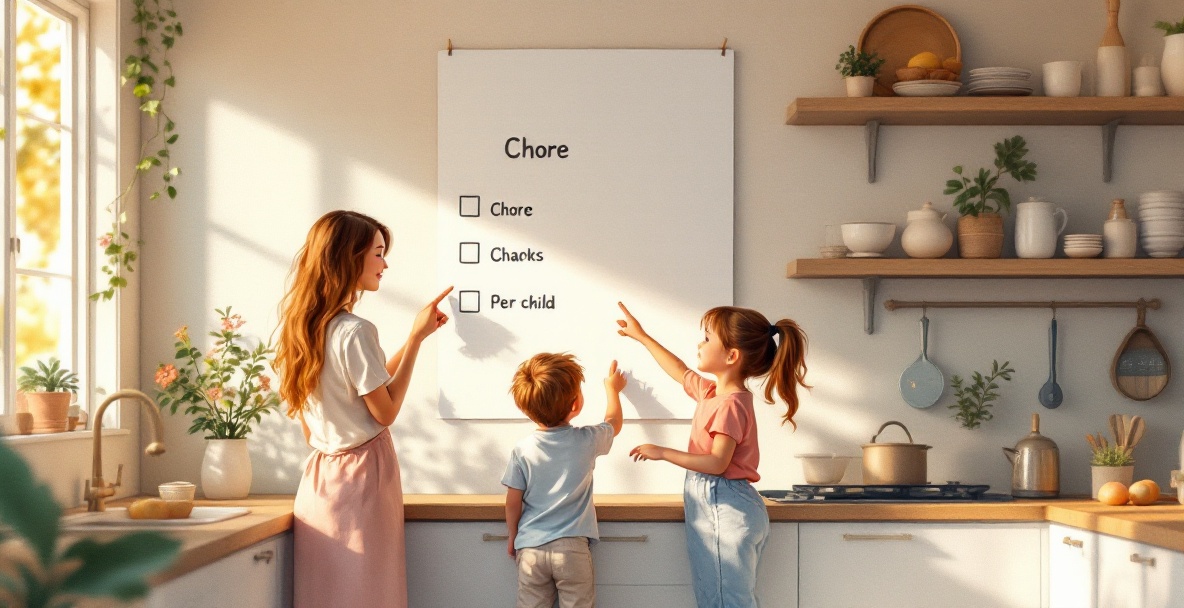
Most classroom-focused advice online talks about whole-group rewards and behavior charts tied to a school day. That doesn't map onto a home, where one or two parents, not a teacher, are tracking everything across mornings, evenings, and sometimes two houses.
The Four Types of Rewards (and Which Work Best at Home)
The four types of rewards are social, privilege-based, token/point systems, and material rewards. Each works differently depending on a child's age and what's being reinforced.
- Social and verbal praise (ages 3-16, low effort): a high-five or specific comment.
- Privilege-based (ages 5-16, low-medium effort): extra screen time, picking dinner.
- Token/point systems (ages 4-14, medium effort): stickers or points redeemed later.
- Material rewards (ages 5-16, medium-high effort): a small toy or allowance bonus.
Token and point systems are the one that scales past a single reward moment. Each completed task adds to a running total, which is the exact mechanism a point-tracking app automates instead of a parent doing mental math every night.
How to Reward Positive Behavior at Home Without Nagging
Reward positive behavior at home by naming the exact action, delivering the reward quickly, and keeping it the same from one caregiver to the next. Here's a practical sequence:
- Pick two or three target behaviors, not ten.
- Decide the reward in advance so you're not improvising.
- Deliver the reward within minutes of the behavior, not at the end of the day.
- Fade material rewards over time as the habit forms, keeping praise.
- Let the child help choose the reward so it sticks longer.
Consistency, not reward size, is what breaks down first. One parent forgets to check a chart, a weekend disrupts the routine, and the whole system quietly stops. For more on fading rewards and connecting chores to real outcomes, see positive reinforcement for kids' chores.
Worth Knowing: A predictable small reward beats an occasional big one for building lasting habits. Size matters less than timing and consistency.
Paper Chart Vs. App: Why Tracking Matters
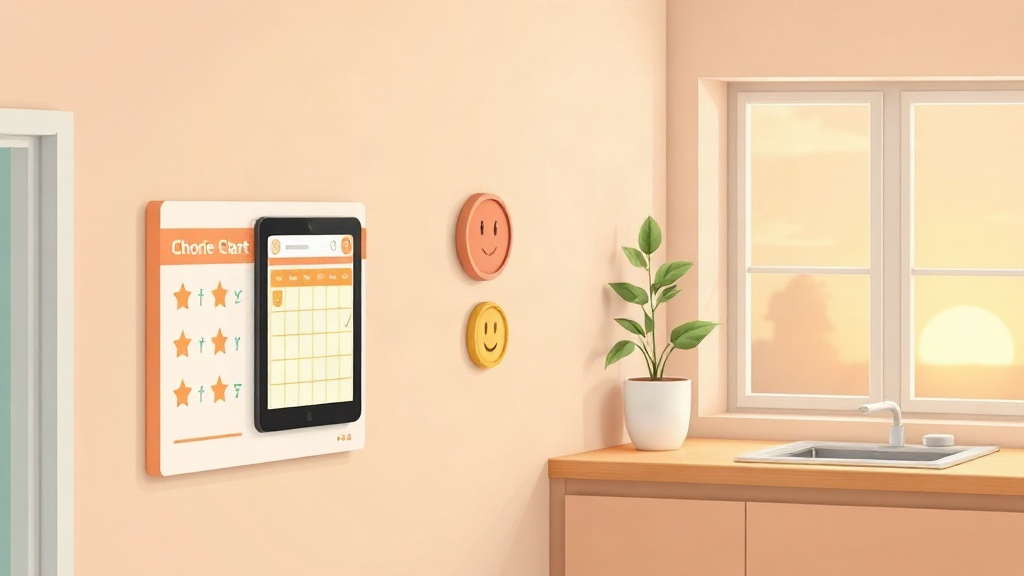
A paper chart tracks behavior by hand; an app tracks it automatically and reminds you when something's due. Both can work, but they fail in different ways.
A sticker chart needs a parent to remember to mark it, add up totals, and remind a child what's left to earn a reward. Nothing nudges you if a day gets skipped. An app logs each completed task the moment it's approved, keeps a running point total, and can send a reminder before something is forgotten.
| Paper Chart | App | |
|---|---|---|
| Tracking | Manual, by hand | Automatic, per task |
| Reminders | None | Built in |
| Across two homes | Hard to sync | Shared dashboard |
| Setup cost | Free | Paid, with free trial |
If you're deciding between several chore apps, the chore and allowance app comparison breaks down six options side by side.
Buying Tip: If chores and rewards only need to work for a week, a paper chart is fine. If you need the system to survive a school year across two caregivers, automated tracking earns its cost back in avoided repetition.
How KidKarma Rewards Positive Behavior
KidKarma rewards positive behavior by letting a parent create a task, a child complete it, a parent approve it, and points land automatically. Kids earn points for completing tasks, unlock rewards, and build positive habits while parents stay organized and connected.
The flow in practice:
- A parent creates a task and assigns it to a child.
- The child marks it done, often by scanning into their own profile with a QR login and a custom avatar.
- A parent approves the completed task from their phone.
- Points post to the child's running total automatically.
- The child redeems points for a reward the parent set up in advance.
KidKarma gives kids the list. You stop repeating yourself. Reviewers describe the practical result: "UI is clean; my daughter loves the colors. Customizable tasks, penalties, rewards with points," one Google Play user wrote. Another called it "Amazing app!! The app is great for organizing daily tasks for kids."
For families weighing KidKarma against another points-based option, the KidKarma vs FamilyRewards comparison lines up features directly.
Running Rewards Across Two Homes
Running a rewards system across two homes requires both caregivers to see the same point totals and approve the same tasks, or the system falls apart within a week. Co-parents share one dashboard and both get approval notifications. Two-Home Sync is included on every plan, Plus or Family, monthly or yearly.
This matters because inconsistency across caregivers is one of the fastest ways a reward system breaks down. If a point earned at one house doesn't carry over to the other, a child stops trusting the system. A shared dashboard removes that gap: both parents see the same list, the same totals, and the same approvals in real time.
What It Costs to Get Started
KidKarma costs $4.99/month or $29.99/year after a 14-day free trial, card required. You won't be charged if you cancel before the trial ends, and a reminder lands on day 11, four days before your trial ends, so there's no surprise charge.
A higher tier runs $7.99/month or $49.99/year, saving 47% on the annual plan. Every plan includes unlimited kids, tasks, and rewards, and Two-Home Sync is included regardless of tier. KidKarma runs no ads and sells no data, so subscriptions are what keep the lights on, and children's accounts are fully managed by parents with minimal data collection.
You can cancel anytime in your App Store or Google Play subscription settings before the trial ends. Start with the KidKarma app to begin the 14-day free trial and see if automated tracking fits your household better than a paper chart.